Algorithmic Repricer vs Rule-Based: Which Wins on Amazon?


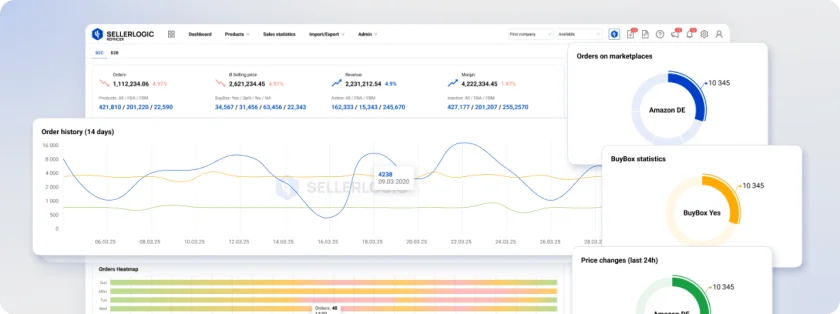
Choosing a pricing strategy on Amazon is no longer about simply being the cheapest. While algorithmic repricing is a category of tools that use mathematical models to adjust prices, implementations vary significantly. SELLERLOGIC Repricer utilizes an AI-driven dynamic algorithm specifically designed to react to competitor price changes. The primary distinction for sellers today is not just speed, but the logic behind the price change: who defines the decision-making process and how the system selects the next price point.
To scale an Amazon business, sellers must differentiate between human-defined rules and system-defined optimization. This guide focuses on the decision logic, maintenance requirements, and practical application of both methods to help you determine which fits your specific SKUs.
Decision Logic: Rules vs. Algorithms
The fundamental difference between these two approaches lies in the "brain" of the operation. Rule-based systems rely on the seller to anticipate market conditions and program specific "If/Then" responses. Algorithmic systems, like the SELLERLOGIC Buy Box strategy, are goal-oriented; the seller defines the objective (e.g., winning the Featured Offer), and the software determines the necessary price movements based on real-time competitor behavior.
| Comparison Factor | Rule-Based Repricing | Algorithmic Repricing |
|---|---|---|
| Logic Ownership | Human-defined: The seller creates the logic (e.g., "Stay $0.10 below the lowest FBA offer"). | Model-defined: The software calculates the price path to reach a specific goal (e.g., the Featured Offer). |
| Configurability | High/Granular: Offers absolute control over which competitors to ignore or follow. | Strategic/Goal-oriented: Configuration focuses on the desired outcome and safety limits (Min/Max). |
| Explainability | Direct: Price changes are easily traced back to a specific rule trigger. | Multi-variable: Prices change based on complex interactions between multiple market actors. |
| Maintenance Effort | High: Rules must be frequently audited and adjusted as competitor behavior changes. | Low: The system adapts to new competitor behaviors without manual rule updates. |
The Algorithmic Decision Cycle and Data Boundaries
An algorithmic repricer functions through a continuous loop of data processing. For SELLERLOGIC Repricer, the cycle involves four key stages: Market Scanning (detecting a competitor price change), Contextual Analysis (identifying who holds the Featured Offer), Strategic Calculation (determining the highest possible price to capture the position), and Price Submission (sending the update to Amazon).
However, this cycle operates within strict data boundaries and technical limitations:
- API Latency: Price changes are not instantaneous; they are subject to Amazon’s API reporting speeds.
- Min/Max Guardrails: The algorithm cannot move outside the user-defined price floor and ceiling.
- Incomplete Data: If a seller provides incomplete cost data, the repricer cannot accurately calculate profitability, only price positions.
- Competing Repricers: If two sellers use aggressive rule-based undercutting against an algorithmic tool, the market may hit "Min" prices rapidly (a "race to the bottom" failure mode).
Worked Scenario: Rule-Based vs. SELLERLOGIC Buy Box Strategy
To understand the difference in output, consider a single SKU (Wholesale Widget) under identical market conditions:
SKU Parameters: Min Price: $20.00 | Max Price: $30.00 | Current Price: $25.00
Competitor Move: A new FBA competitor enters the listing at $24.50.
Output A: Rule-Based Strategy ("Undercut Lowest by $0.01")
The system triggers the rule and moves your price to $24.49. If the competitor has a similar rule, the prices will continue to drop by $0.01 increments until one hits their Minimum. The logic is purely reactive and downward-facing.
Output B: SELLERLOGIC Buy Box Strategy
The algorithm may initially drop the price to $24.40 to aggressively secure the Featured Offer. Once the position is won, the algorithm begins its "price climbing" phase. It may test $24.45, then $24.55. If it can maintain the Featured Offer at $24.55 (even if the competitor is at $24.50) due to other seller performance factors, it will hold that higher price to maximize margin.
Safeguards and Practical Limitations
Automated pricing requires active monitoring to prevent errors. Common failure modes include:
- Pricing Suppressions: If your Max price is set significantly higher than the "Marketplace Fair Price" or the recent average, Amazon may deactivate the listing.
- Unrealistic Min/Max: Setting a Minimum price too close to the Maximum prevents the algorithm from having enough "room" to maneuver and test price points.
- Rollback Criteria: Sellers should define criteria for when to revert to a manual strategy, such as when a SKU’s conversion rate drops despite holding the Featured Offer.
30-Day Evaluation Framework
To measure the effectiveness of an algorithmic transition, use this structured framework rather than checking daily fluctuations:
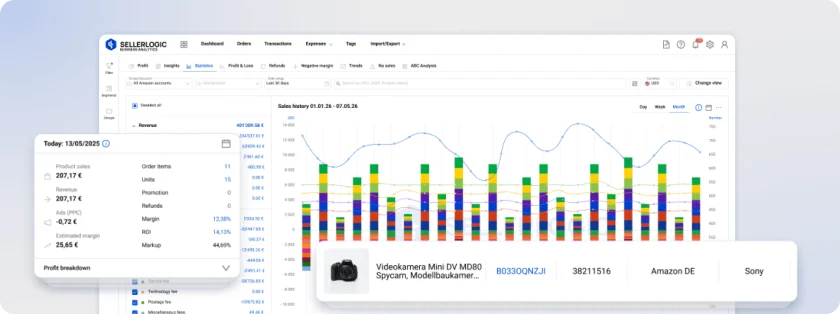
- Days 1-7 (Baseline): Run your existing rules and document your average Featured Offer (Buy Box) percentage and contribution margin per unit. Amazon seller analytics tools like SELLERLOGIC Business Analytics show profit per product after costs and fees, which makes this baseline easier to measure.
- Days 8-14 (Pilot Phase): Move a test cohort (10-20% of SKUs) to a SELLERLOGIC algorithmic strategy. Ensure Min/Max limits are calculated based on current COGS and fees.
- Days 15-28 (Optimization): Monitor for "floor-hitting" (SKUs stuck at Min price). Adjust strategies for those SKUs—for example, switching from Buy Box to Push if inventory clearance is required.
- Days 29-30 (Analysis): Compare the test cohort against the baseline. A successful implementation should show a stable or increased Featured Offer share with an improved or maintained average selling price (ASP).
By shifting the focus from "how fast can we change price" to "how can we intelligently find the price ceiling," sellers can use the SELLERLOGIC Repricer to maintain a competitive edge without the constant manual maintenance required by traditional rule-based sets.
Ready to test an algorithmic strategy on your own SKUs? Start with a small pilot cohort, set realistic Min/Max limits, and follow the 30-day framework above. With the SELLERLOGIC amazon repricer tool, you can automate price optimization, win the Featured Offer, and protect your profit margins without constant manual rule maintenance.
Our products